Emergency lighting testing is the part of building safety that everyone agrees is important and almost everyone puts off. The lights sit quietly in the ceiling for years, and it


 English
 English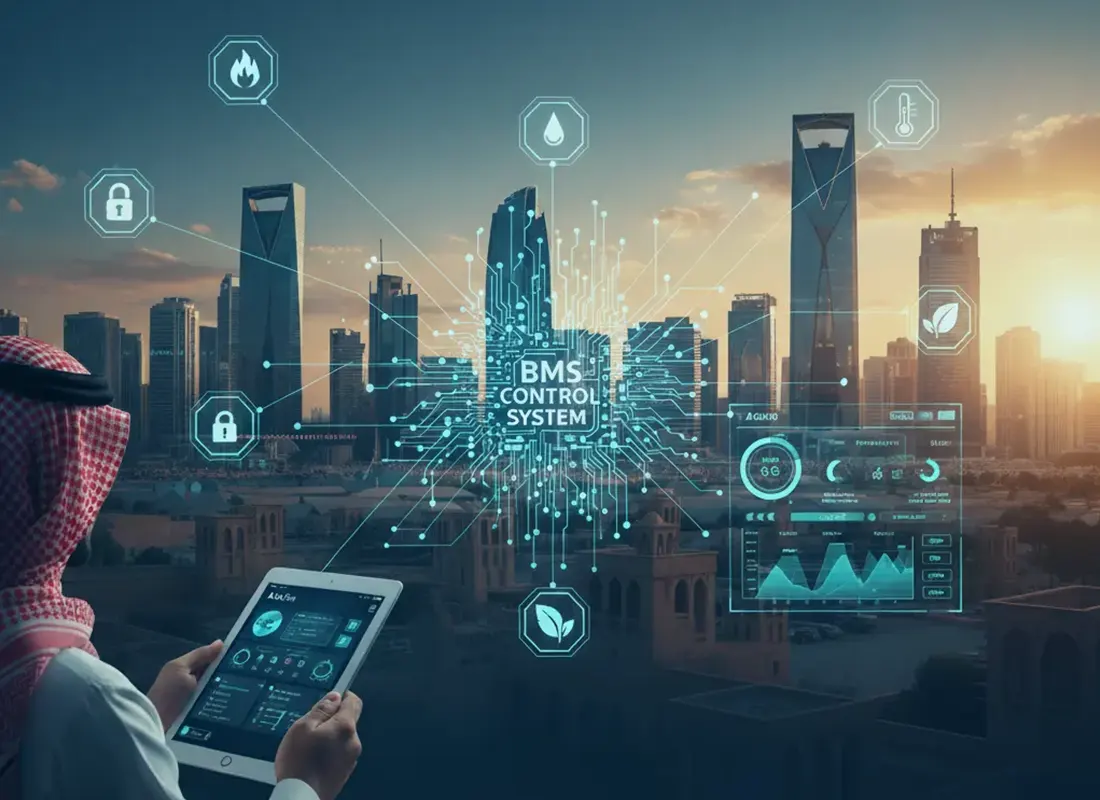
Consider the modern skylines of Riyadh and Jeddah, as well as the emerging economic cities. You see gleaming towers and ambitious projects, such as NEOM, symbols of a nation rapidly advancing under Vision 2030. But what you don’t see is the invisible, intelligent technology that brings these structures to life, making them efficient, sustainable, and comfortable. This is the realm of the Building Management System (BMS).
A BMS building management system is the silent, automated conductor orchestrating a building’s core functions. For facility managers and business owners, it represents a transformative shift from manually checking thermostats and electrical panels to having a single, intelligent platform that controls everything from air conditioning and lighting to power and security. As the Kingdom focuses on smart city development, energy conservation, and operational excellence, understanding what a BMS system is and how it can be leveraged is no longer a luxury—it’s a strategic necessity for any modern commercial property.
This guide will demystify the BMS control system, explaining how it works, its key components, and why it is the cornerstone of a smarter, more efficient building in the Saudi context.
In its simplest terms, a Building Management System (BMS) is a computer-based control system installed in buildings to monitor and manage mechanical, electrical, and electromechanical systems. Think of it as an integrated command center for your building’s core operations.
But what is a BMS system in practice? It’s the technology that allows a facilities manager in Riyadh to ensure air conditioning is perfectly set across all floors of an office tower without manually adjusting dozens of thermostats. It’s the system that automatically turns off lights in the empty corridors of the Jeddah shopping mall and adjusts ventilation based on the number of people present. A BMS building management system seamlessly connects and automates a wide range of functions, including:
By integrating these disparate systems into a single, unified platform, a BMS moves building management from reactive problem-solving to proactive, intelligent optimization. It provides the control and data needed to reduce energy consumption, lower operational costs, and enhance occupant comfort—a key trifecta in Saudi Arabia’s competitive commercial landscape.
Understanding how a BMS system works is key to appreciating its value. It operates on a continuous, automated cycle of monitoring, analysis, and action. This “intelligence loop” happens seamlessly in the background, ensuring optimal building performance 24/7. Let’s break down how a BMS system works in four clear steps:
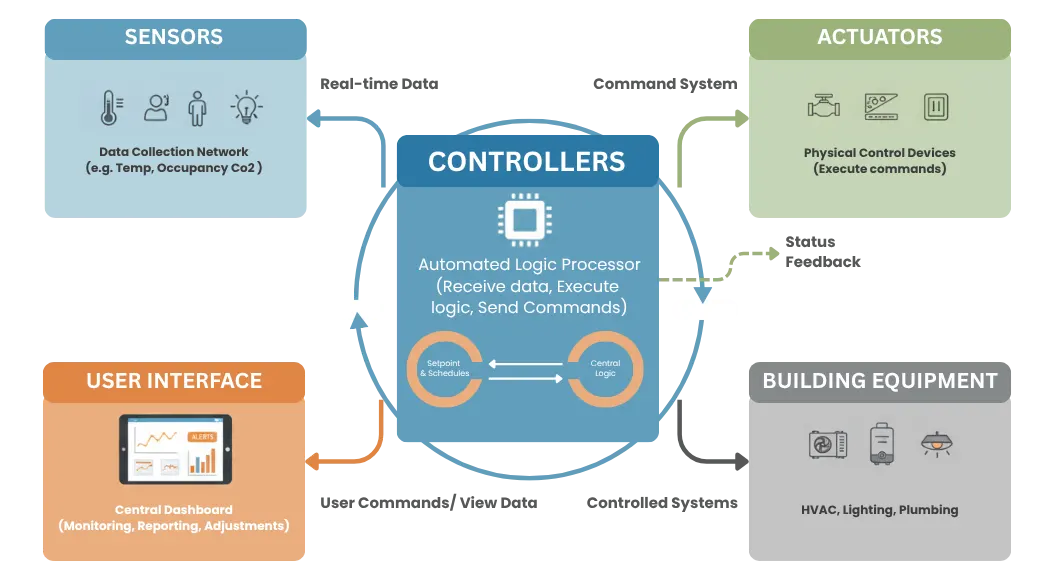
This automated loop eliminates human error and delay. Instead of a technician walking to a boiler room to check a pressure gauge, the BMS control system monitors it remotely. It can automatically shut down the boiler if unsafe pressure is detected, ensuring both efficiency and safety.
A BMS control system is not a single device but a sophisticated network of hardware and software working in concert. Understanding the core BMS system components helps demystify the technology and illustrates how the “intelligence loop” is physically achieved. Here are the essential building blocks:
Sensors are the eyes and ears of the system, deployed throughout the building to measure physical conditions continuously. They form the critical data-gathering layer. Common examples include:
Controllers are the computational heart of the operation. They receive data from the sensors, execute control logic based on pre-programmed setpoints and schedules, and send out command signals. They range from compact unit controllers that manage a single device (such as a fan coil) to large network-level panels that oversee entire system zones.
Actuators are components that execute commands. They convert electrical signals from the controllers into physical action. For example, an actuator might:
This is the software platform where humans interact with the BMS. It provides a graphical overview of the entire building, displaying real-time data, historical trends, and alarm notifications in one view. Authorized personnel can use this dashboard to adjust setpoints, create schedules, and generate energy and maintenance reports from any connected device.
Together, these BMS system components create a responsive, automated ecosystem that transforms a static building into a dynamic, intelligent asset.
When exploring how a BMS system works, you will frequently encounter the term DDC. So, what is DDC in a BMS system? DDC stands for Direct Digital Control, the fundamental technology that enables the sophisticated automation we’ve described. It refers to the use of digital, microprocessor-based controllers to directly monitor and manage building systems, replacing older, less efficient analog methods.
In a DDC system, the controllers receive real-time sensor data, process it with complex, customizable logic, and send precise digital commands to the actuators. This allows for far more nuanced and efficient control than before.
Many older buildings, even some in Saudi Arabia, still use pneumatic controls, which rely on compressed air to operate valves and dampers. Here’s why DDC is a superior choice for modernizing Saudi infrastructure:
In essence, DDC is the “smart” in a smart building. It transforms a BMS building management system from a simple monitoring tool into an active, automated management platform that delivers tangible returns on investment.
Understanding how to install a BMS system is crucial for planning a successful project. Proper installation is a methodical process, not a hasty setup. For commercial buildings in Saudi Arabia, a phased approach ensures minimal disruption to daily operations and guarantees the system performs as intended. Here is a general overview of the key stages:
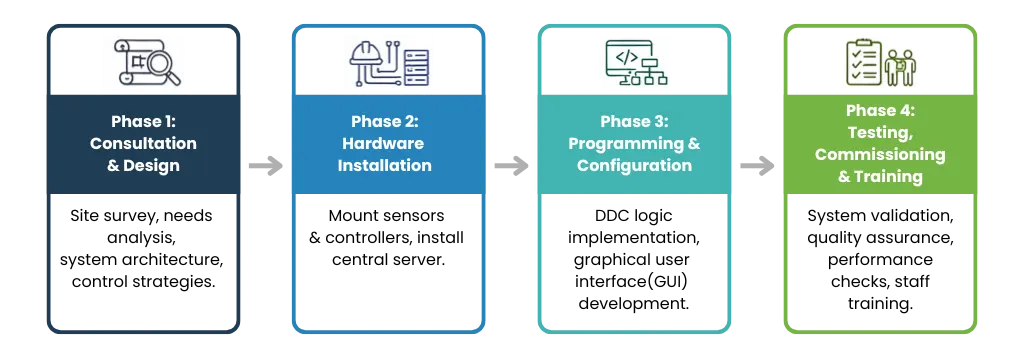
This is the most critical phase. It involves a deep dive into your building’s specific needs, existing systems, and operational goals. Specialists will conduct a site survey, interview facility staff, and design a detailed plan. This plan specifies the BMS system components required, their locations, network architecture, and the control strategies (the automated “if-this-then-that” logic) that will drive efficiency.
Once the design is approved, the physical installation begins. This involves:
Once the hardware is in place, the system comes to life. Engineers program the DDC controllers with the specific logic designed in Phase 1. They also build the graphical user interface, creating an intuitive digital replica of your building that lets you monitor and control every connected point.
Before going live, the entire system undergoes rigorous testing and quality assurance to ensure its reliability and accuracy. Every sensor, controller, and actuator is thoroughly checked to ensure they function correctly both as individual components and as part of an integrated system. This “commissioning” process is vital for performance validation. Finally, comprehensive training is provided for your facility management team, empowering them to use the new BMS control system effectively.
A well-executed installation is the foundation for reaping all the benefits of a BMS.
Saudi Arabia’s BMS adoption is more than just an operational upgrade; it’s a strategic alignment with the nation’s transformative goals. As Saudi Arabia pursues its Vision 2030 objectives of a diversified economy, sustainable development, and enhanced quality of life, intelligent building technology has become a critical enabler. The deployment of the BMS system in Saudi Arabia’s major cities like Riyadh, Jeddah, Madinah and other major urban centers is at the forefront of this modernization wave.
In bustling commercial hubs like Riyadh’s King Abdullah Financial District (KAFD) or Jeddah’s upcoming mega-projects, the scale and complexity of building operations are immense. A BMS system in Riyadh high-rises is no longer optional but essential for:
Vision 2030 emphasizes environmental sustainability. A modern BMS building management system is one of the most effective tools for achieving these targets, as it systematically reduces energy and water consumption in buildings, which are major resource consumers. A BMS directly contributes to the Kingdom’s green goals. This is especially relevant for projects aiming for international sustainability certifications, which are becoming a benchmark for premium real estate in the region.
From NEOM’s futuristic ambitions to the urban transformation of existing cities, the BMS control system is the foundational technology that makes buildings not just smarter, but more resilient, efficient, and ready for the future.
Investing in a modern BMS building management system delivers a powerful return on investment that extends far beyond reduced utility bills. For business owners and facility managers in Saudi Arabia, the advantages are multifaceted, impacting the bottom line, operational resilience, and asset value. Here are the key benefits:
In essence, a BMS transforms a building from a cost center into a strategic, efficient, and high-performing asset.
The world of BMS control system technology is rapidly evolving, moving beyond basic automation towards intelligent, data-driven building ecosystems. For forward-thinking projects in Saudi Arabia, embracing these trends is key to creating truly future-ready infrastructure. Here are the latest advancements shaping the industry:
Modern BMS platforms incorporate artificial intelligence (AI) and machine learning to move from reactive control to predictive optimization. These systems can analyze vast amounts of historical and real-time data to identify patterns and inefficiencies invisible to the human eye. For instance, Siemens highlights the potential of AI in its building tech, stating it can enable “predictive maintenance and advanced energy optimization,” allowing systems to self-adjust for peak performance and flag maintenance needs before failures occur.
As BMS building management systems become increasingly connected, they become a vital component of a building’s digital infrastructure. Cybersecurity is now a top priority. Leading vendors, such as Honeywell and Johnson Controls, are heavily investing in building robust security protocols directly into their control systems and software to protect against cyber threats, thereby ensuring the operational integrity and safety of smart buildings.
The shift to cloud-based management and the integration of the Internet of Things (IoT) is breaking down traditional silos. A cloud-based BMS system enables the remote management of multiple buildings from a single pane of glass, making it ideal for corporations with portfolios spanning Riyadh, Jeddah, and beyond. Furthermore, IoT sensors provide a new layer of granular, low-cost data, enabling hyper-specific control over building environments and unlocking new levels of efficiency, as Schneider Electric’s vision for IoT in building management explores.
These trends converge to create buildings that are not only automated but also adaptive, resilient, and continuously improving—cornerstones for the next generation of Saudi smart cities.
At Aala Tech, we don’t just install systems; we deliver intelligent building solutions tailored to Saudi Arabia’s unique demands and ambitious vision. We understand that a BMS system in Riyadh must withstand extreme climate conditions while optimizing energy use, and a BMS system in Jeddah must support the bustling commercial activity of the Red Sea coast. Our deep local expertise, combined with our technical excellence, makes us the ideal partner for your building automation journey.
We guide you through every step of the process, ensuring a seamless transition to a smarter, more efficient building:
Aala Tech is committed to powering the Kingdom’s progress. By providing state-of-the-art Building Automation and Control Systems, we empower businesses to reduce operational costs, enhance environmental stewardship, and create superior spaces for people to work and thrive. We are proud to contribute to the realization of Vision 2030 by making Saudi Arabia’s buildings smarter, one project at a time.
A Building Management System is no longer a luxury for modern commercial properties in Saudi Arabia; it is the foundational technology for operational excellence, sustainability, and enhanced comfort. From understanding what a BMS system is and how it works, to recognizing its critical role in supporting Vision 2030, the case for integration is clear and compelling.
The journey to a smarter building begins with the right partner. Aala Tech combines deep local knowledge with technical expertise to deliver BMS solutions in Saudi Arabia that are not only installed but also truly optimized for the Saudi environment.
Ready to unlock your property’s full potential? Contact Aala Tech today for a comprehensive consultation. Let us demonstrate how our tailored BMS solutions can reduce your costs, future-proof your asset, and contribute to a more efficient Saudi Arabia.
