Every facility manager in the Kingdom has heard the pitch: install smart lighting control and cut your electricity bill. Few have seen the actual math. This guide gives you real

 English
 English
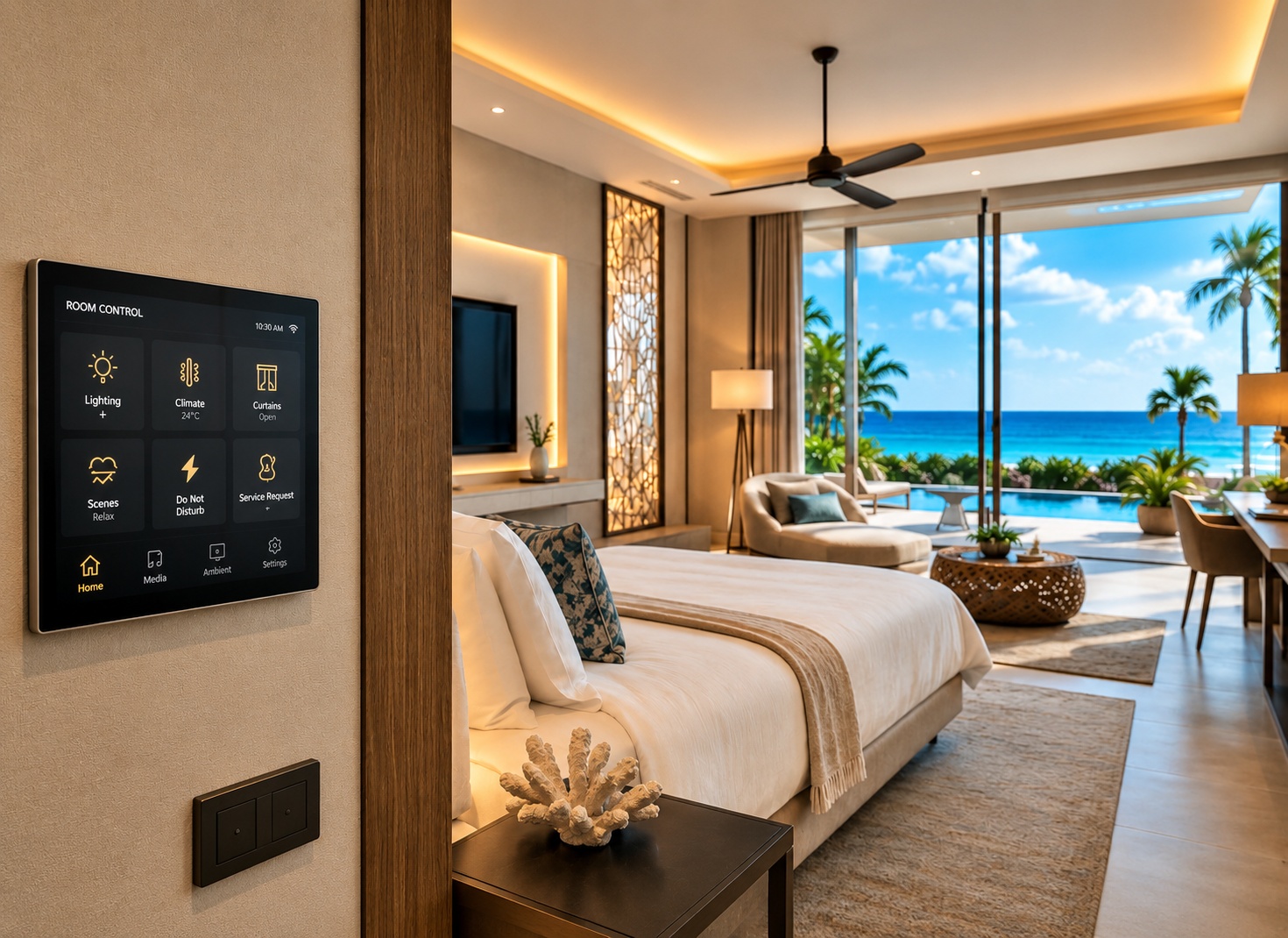
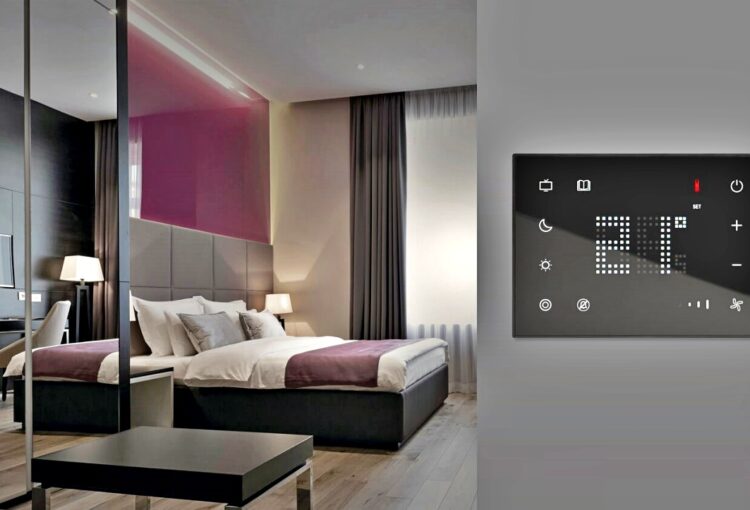
 A guest room management system is an integrated technology platform that centralizes and automates the control of all in-room systems, including lighting, HVAC, curtains, entertainment, door locks, and housekeeping signals, through a single intelligent network. Rather than relying on isolated controls or manual staff interventions, a GRMS connects every room function to a central dashboard, giving hotel managers real-time visibility across all rooms while giving guests intuitive control over their personal environment.
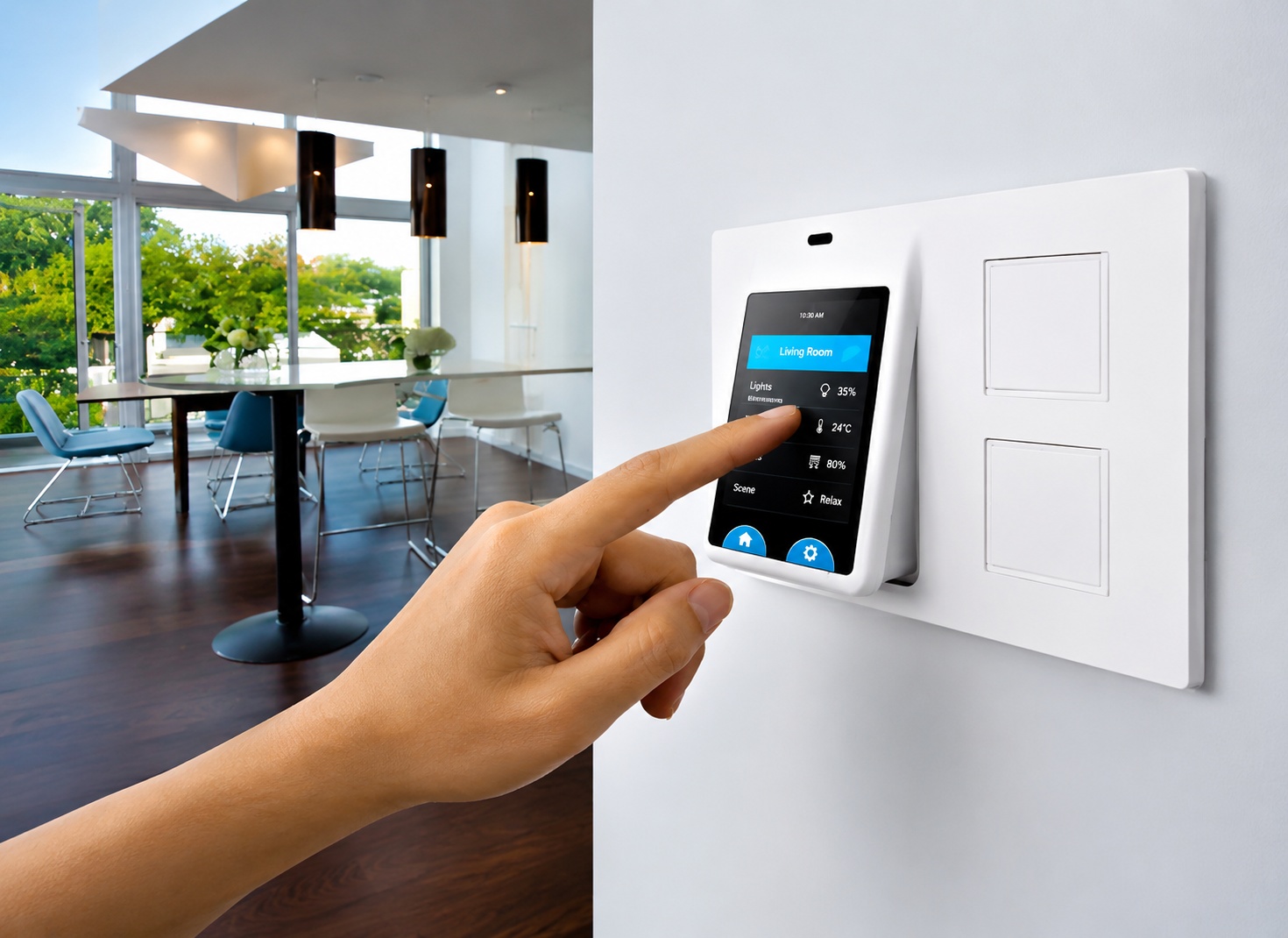
At the room level, guests interact through wall-mounted touch panels, bedside controllers, or mobile apps to adjust lighting scenes, set preferred temperatures, request housekeeping, or activate ‘Do Not Disturb’ mode. At the operations level, hotel managers can monitor energy consumption by room, track maintenance alerts, and integrate occupancy data with the property management system (PMS) and building management system (BMS), all from one platform.
| Key stat: Hotels using a GRMS report up to 20% savings on utility costs. For a 200-room hotel spending SAR 1.8 million annually on energy, this represents potential savings of SAR 360,000 per year. (Source: Aala Tech Industry Benchmarks for KSA Hotels) |
Saudi Arabia’s hospitality industry is entering a golden decade. According to Knight Frank’s 2025 Saudi Arabia Hospitality Market Review, the Kingdom’s total hotel stock reached 167,500 keys by Q1 2025, with 78% of the entire pipeline (99,500 additional keys under construction or planning) falling in the luxury, upscale, or upper-upscale segments. This is where GRMS is not optional; it is expected. The pressure is not just from supply. Demand is soaring: total tourist trips hit 115.9 million in 2024, exceeding Vision 2030’s initial target of 100 million visitors ahead of schedule, according to Travel and Tour World. Non-religious travelers now represent 59% of all international arrivals, up sharply from 44% in 2019, bringing a new class of experience-driven guests who expect seamless, technology-enabled stays. These guests have stayed in smart hotels in London, Dubai, and Singapore. They know what a connected room feels like. When they arrive at a Saudi hotel that still runs on manual thermostats and traditional light switches, the contrast is jarring. A guest room management system closes that gap.
Saudi Arabia’s government has committed to transforming tourism into a 10%+ contributor to GDP. As part of Vision 2030, over SAR 444 billion in tourism GDP was recorded in 2024, the highest in the region. Mega-projects like NEOM, The Red Sea Project, and Qiddiya are creating thousands of new premium rooms, all of which will require intelligent room management infrastructure. Hotels that invest in GRMS now are investing in the technological backbone that these properties will run on for the next decade.
For hoteliers in established markets like Riyadh and Dammam, this boom represents both opportunity and threat. The opportunity: higher ADR and occupancy driven by growing tourism. The threat: competition from 99,500 new, smart, purpose-built rooms entering the market by 2030. Differentiation requires investment in guest experience technology, and GRMS is where that investment delivers the highest measurable ROI.
Understanding how a GRMS functions in practice helps hotel managers evaluate which system is right for their property. Here is a typical operational flow from a guest’s check-in to checkout.
When a reservation is confirmed in the property management system (PMS), the GRMS automatically prepares the room. Air conditioning starts adjusting to the guest’s pre-set preferred temperature (if a returning guest profile exists) approximately 30-60 minutes before arrival. Lighting is set to a ‘welcome’ scene. The keycard or mobile key is programmed to activate room systems upon entry.
The guest inserts their keycard into the room’s energy controller or taps their mobile credential at the door. The GRMS activates all pre-configured room systems simultaneously: lights come on to the welcome scene, the HVAC resumes active operation, the television displays a personalized welcome message if integrated, and the guest’s profile (returning guests) pre-loads preferences for temperature and lighting.
During the stay, guests use wall-mounted touch panels, bedside consoles, or a mobile app to adjust their environment. They can select lighting scenes (bright work mode, ambient dinner setting, sleep mode), set precise temperatures, close motorized blinds, activate DND, or request housekeeping service. All of these actions are logged in the central management dashboard, giving staff real-time insight into room status without physically entering the room.
Occupancy sensors, as part of integrated control and automation systems, continuously monitor whether the room is occupied. When a guest leaves the room, without checking out, the GRMS automatically transitions to energy-saving mode: HVAC setpoint shifts by 3-4°C toward ambient, non-essential lights turn off, and entertainment systems power down. Industry data shows hotel rooms are unoccupied for an average of 12 hours per day, meaning this automation alone, made possible through advanced control and automation systems, captures significant energy savings without affecting guest comfort.
From Check-In to Checkout: How GRMS Enhances Hotel Operations becomes clearly evident at the checkout stage. At checkout, either triggered by the PMS or keycard removal, the GRMS enters a full standby mode: HVAC operates at minimum maintenance setpoints, all lights extinguish, and a housekeeping alert is sent to the staff dashboard. Housekeeping staff can update room status directly from the GRMS interface, eliminating the need for manual phone calls and reducing room turnaround time.
| Ready to explore GRMS for your hotel? Aala Tech delivers intelligent guest room management systems across Saudi Arabia with proven projects at Marriott Jazan, InterContinental Abha, Radisson Blu Hail, and more. Contact our team for a free site assessment. |
Modern hotel guests rank temperature control among the top five factors affecting their satisfaction, according to J.D. Power research. A GRMS ensures every room is at the perfect temperature before the guest walks through the door, lighting transitions seamlessly from bright to ambient, and every preference is one touch away. Hotels that deploy smart room systems report a 15% increase in positive guest feedback related to comfort. For properties competing in Saudi Arabia’s premium hospitality market, this translates directly into higher review scores, stronger repeat bookings, and measurable RevPAR growth.
For returning guests, the GRMS stores preference profiles, preferred temperature, lighting scenes, and pillow type requests logged via service panels, creating a personalized experience that builds genuine loyalty. In a market where 78% of guests expect personalized services, this capability shifts a hotel from ‘good’ to ‘remarkable.’
Energy is one of the highest operational costs in any hotel. Saudi hotels consume between 12,000 and 15,000 kWh per room annually on average, with HVAC systems accounting for 40-50% of total electricity expenditure. Without a GRMS, heating and cooling systems run continuously in unoccupied rooms, wasting 60-80% of the energy they would use if the room were occupied.
A properly implemented GRMS, integrated with a lighting control system, can reduce overall hotel energy costs by 25-35%, according to data from the U.S. Department of Energy and ENERGY STAR benchmarking programs. For a 150-room hotel in Riyadh spending SAR 1.5 million annually on energy, a 30% reduction represents SAR 450,000 in annual savings, with ROI on the GRMS investment typically achieved within 12 to 18 months. The International Energy Agency (IEA) reports that hotels adopting smart HVAC and room controls reduce HVAC consumption by 20-30%, specifically, with a 200-room hotel saving up to $20,000 (SAR 75,000) annually on HVAC alone.
Additionally, the U.S. Department of Energy has reported that cutting energy consumption by just 10%, achievable in part through an intelligent lighting control system, produces the same financial effect as increasing average daily room rate by $1.35 per room, a compelling way to frame the GRMS ROI conversation for hotel owners.
Without a GRMS, hotel operations staff spend significant time manually checking room status, responding to maintenance calls for issues they cannot remotely diagnose, and coordinating between housekeeping, engineering, and front desk teams through inefficient phone calls. A GRMS eliminates this friction. The central dashboard displays real-time status for every room: occupancy state, temperature, HVAC faults, DND/MUR status, and energy consumption. When a fault occurs, say, with an HVAC control system, a unit in room 412 exceeds its setpoint, the engineering team receives an automatic alert and can respond proactively before the guest notices anything wrong.
This operational visibility has a measurable impact on staff productivity. Housekeeping teams can prioritize rooms by checkout order rather than physically walking corridors. Front desk staff can assign rooms based on real-time readiness rather than guesswork. Engineering can schedule preventive maintenance during the windows when rooms are least likely to be occupied. The result is a leaner, more responsive operation with fewer complaints and faster resolution times.
A GRMS does not operate in isolation; it becomes the intelligent layer that connects the room environment with the broader hotel management ecosystem. In modern Saudi Arabia hotel projects, the GRMS integrates bidirectionally with the building management system (BMS) to share occupancy data, energy consumption reporting, and equipment health signals. It connects with the property management system (PMS) to trigger room preparation workflows on check-in and automated shutdown on checkout. It interfaces with door lock systems to verify occupancy state, and with keycard systems to activate energy controllers. This integration ecosystem transforms a GRMS from a comfort tool into the central nervous system of hotel operations.
Saudi Arabia’s Vision 2030 explicitly prioritizes sustainable tourism, and global hotel brands operating in the Kingdom face increasing pressure from international parent companies and environmentally conscious travelers to demonstrate measurable sustainability progress. A GRMS provides the data infrastructure to support ESG reporting: real-time energy consumption tracking by room, floor, and property; automated reduction of energy waste from unoccupied spaces; and documented percentage reductions in carbon-equivalent emissions. Hotels that can quantify their sustainability performance attract both the growing segment of eco-conscious travelers and the international corporate travel programs that increasingly mandate green hotel certifications.
Energy savings are often the primary ROI driver cited by hotel general managers when evaluating GRMS investment. According to the 2025 Tech Report on Energy Management in Hospitality, smart room technology continues to deliver measurable returns across hotel categories globally. Here is a consolidated view of the key benchmarks relevant to Saudi Arabia’s hotel market.
| Metric | Benchmark | Source |
|---|---|---|
| Avg. energy cost per hotel room (KSA) | 12,000–15,000 kWh/year | Aala Tech KSA benchmarks |
| HVAC share of hotel energy consumption | 40–50% | IEA / Schneider Electric |
| Energy saved via GRMS (overall) | 25–35% | U.S. DOE / ENERGY STAR |
| HVAC savings via smart controls | 20–30% | International Energy Agency (IEA) |
| HVAC runtime reduction via occupancy sensing | Up to 45% | Verdant/Copeland Research |
| Guest satisfaction improvement (comfort) | +15% positive feedback | Hotel Management Magazine |
| Typical ROI payback period | 12–18 months | Multiple industry sources |
| % rooms unoccupied per day (average) | ~50% daily | ENERGY STAR / DOE research |
| Energy wasted in unoccupied rooms | 60–80% of the occupied rate | Envigilance Hotel Research |

For Saudi hoteliers, the most relevant calculation is straightforward: take your annual energy spend, apply a conservative 25% reduction assumption, and compare the result to the GRMS investment cost. In the vast majority of cases, particularly for properties with 80+ rooms, the system pays for itself within the first 12 to 24 months and delivers measurable returns for the remainder of its operational life (typically 10-15+ years).
One of the most common concerns hotel operators raise when evaluating a guest room management system is integration complexity. How does it connect with the systems already in place? The answer, for a well-designed GRMS like those supplied by Aala Tech, is: seamlessly.
The GRMS feeds room-level occupancy and energy data into the broader building management system, enabling property-wide energy optimization. When the GRMS detects that 40% of rooms on a floor are unoccupied, the BMS can adjust the floor’s air handling units to reduce supply airflow accordingly, multiplying the energy savings far beyond what either system could achieve independently. Aala Tech’s GRMS solutions integrate natively with Honeywell building management platforms, ensuring a unified data environment across both room-level and property-level systems.
Direct PMS integration is what transforms the GRMS from a comfort system into an operational tool. When a reservation is checked in through the front desk PMS, the GRMS automatically activates room preparation. When checkout is processed, the GRMS transitions to standby. This eliminates manual workflow steps, reduces the risk of errors, and creates a seamless bridge between guest-facing hospitality operations and back-of-house technology. Most modern hotel PMS platforms, including Opera, Protel, and Fidelio, support standardized GRMS integration protocols.
Electronic door lock integration, as part of broader access control systems, allows the GRMS to verify room occupancy state independently of motion sensor data, providing a more accurate occupancy signal. When the guest inserts their keycard into the room’s energy controller, the GRMS registers the room as occupied and activates full services. When the keycard is removed, the GRMS begins the energy-saving countdown. This keycard integration, enabled by access control systems, also enables mobile key credential support, where the guest’s smartphone serves as both room key and room controller via the hotel’s app.
Meters & Billing System Integration
The GRMS integrates directly with smart meters and billing systems to deliver granular, room-level energy consumption data in real time. This integration enables hotel operators to monitor exactly how much electricity, water, and HVAC energy each room consumes per stay, per day, or across any reporting period. For properties operating under a tenant billing or apartment-hotel model, this data feeds directly into the billing system, enabling accurate, automated utility cost allocation per guest or unit without manual meter reading. Beyond billing, the meters and billing system integration supports utility benchmarking, helping operators identify high-consumption rooms, detect equipment anomalies, and validate the energy savings delivered by the GRMS against actual metered data, providing an auditable, data-driven record of ROI.
Selecting and implementing a guest room management system is a significant decision. This section provides a practical framework for Saudi hotel operators evaluating their options.
Start by defining your primary objectives. Are you focused primarily on energy savings? Guest experience enhancement? Operational efficiency? Brand compliance with a global flag that mandates smart room technology? Your priority determines which GRMS capabilities matter most and should drive the specification process.
Aala Tech partners with two of the hospitality industry’s most trusted GRMS manufacturers: Honeywell Inncom and Orbita. Honeywell Inncom has been installed in thousands of hotels across 50+ countries since 1986, operating on the PC-502.RF protocol with the E7 controller as its flagship platform. Orbita, established in 2004 and deployed in over 120 countries, uses RS485, Zigbee, and proprietary RF protocols with its Room Control Unit (RCU). Both platforms support full PMS and BMS integration and offer a range of guest-facing interface options from sleek wall panels to mobile app control that Saudi Arabia’s premium hotel market demands.
GRMS installation is best executed in phases, particularly for operational hotels undergoing retrofit. Typical timelines for a 150-200 room property run 8-14 weeks from equipment delivery to commissioning. The installation sequence generally follows: central server and network infrastructure → floor-by-floor RCU installation → sensor and switch deployment → guest interface panels → integration testing with PMS and BMS → staff training → phased room activation.
For new-build hotel projects in Saudi Arabia, particularly the thousands of rooms entering the pipeline for NEOM, the Red Sea Project, and Riyadh’s expanding KAFD district, the GRMS specification should happen at the MEP design stage, before wiring and conduit are installed. Retrofitting GRMS into a finished hotel costs significantly more than integrating it during construction.
A GRMS is only as effective as the team managing it. Front desk staff need to understand how the PMS-GRMS integration affects check-in and checkout workflows. Housekeeping supervisors need to use the room status dashboard to prioritize cleaning. Engineering staff need to interpret GRMS fault alerts and understand first-line response protocols. Aala Tech provides comprehensive training as part of every GRMS installation, ensuring your team is confident operating the system from day one.
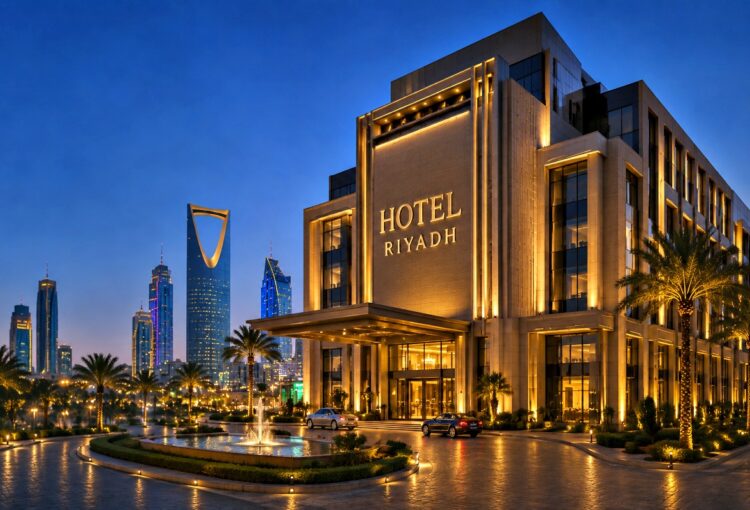
Riyadh is the epicenter of Saudi Arabia’s hospitality transformation. With 82% of the city’s development pipeline classified as luxury or upper-upscale properties, hotel operators in the capital face both the highest guest expectations and the most intense competitive pressure of any market in the Kingdom. Smart room automation is no longer a differentiator in Riyadh; it is table stakes for any property serious about competing for the premium guest segment.
Aala Tech’s guest room management system solutions in Riyadh are deployed across commercial, government, and hospitality projects in the city, backed by a local team with deep knowledge of the Saudi building codes, MEP standards, and hospitality brand requirements that govern development in the capital. Whether your Riyadh property is a new-build luxury tower in KAFD or an established business hotel undergoing a technology refresh, our GRMS solutions are designed for rapid, reliable deployment with minimal disruption to operations.
Explore our dedicated resource for GRMS solutions in Riyadh to learn more about our local hospitality project experience and capabilities.
Dammam and the Eastern Province represent a distinct and growing hospitality market, driven by corporate travel, the energy sector, and increasing leisure tourism from neighboring GCC markets. Hotels in this market compete on reliability, efficiency, and the ability to serve both the demanding corporate guest and the leisure traveler, a combination that GRMS is uniquely suited to support.
Aala Tech provides expert guest room management system installation and support in Dammam, backed by a regional presence that ensures responsive technical support and on-site service when your property needs it. Our Dammam GRMS solutions are fully compatible with all major hotel brands operating in the Eastern Province and integrate with the building management system, access control, and CCTV infrastructure that modern hotel security standards require.
Learn more about our GRMS System Solutions in Dammam, including project experience and local support capabilities.
| Ready to transform your hotel’s guest experience and cut energy costs? Aala Tech is Saudi Arabia’s trusted GRMS specialist with completed projects at Marriott, InterContinental, Hilton, Radisson Blu, and Oberoi. Contact our team today for a free consultation and property assessment. We’ll help you build the business case, specify the right system, and deliver a GRMS that pays for itself. |
Saudi Arabia’s hospitality sector is at an inflection point. With 127 million tourists in 2024, 362,000 new hotel rooms planned by 2030, and a hospitality market projected to grow from USD 51.5 billion to USD 111 billion by 2034, the opportunity for hotel operators has never been greater. But so has the competition. In this environment, the hotels that invest in intelligent guest room management systems today are the ones that will command premium rates, earn loyal repeat guests, and run cost-efficient operations that support long-term profitability.
A GRMS is not a cost; it is a strategic investment with a measurable return. Energy savings of 25-35% with an 18-month ROI, 15% improvements in guest satisfaction scores, and the operational efficiency of a centralized room management dashboard: these are outcomes that flow directly to a hotel’s bottom line. Combined with seamless integration into building management systems, PMS platforms, and access control infrastructure, a modern GRMS from Aala Tech gives Saudi hotel operators the technology foundation they need to compete and win.
Whether you operate a boutique property in Riyadh, a business hotel in Dammam, or are planning a new luxury development for one of Saudi Arabia’s mega-projects, Aala Tech’s guest room management system solutions are engineered for your market and backed by a proven track record with the Kingdom’s most prestigious hospitality brands.
