Central Battery vs Self-Contained Emergency Lighting in Saudi Arabia
When the power fails in a Riyadh tower, Jeddah hotel, or Dammam industrial facility, the emergency lighting system is the difference between an orderly evacuation and chaos. Facility managers across the Kingdom face a clear choice: self-contained units with individual batteries or a central battery system that powers every fitting from one location.
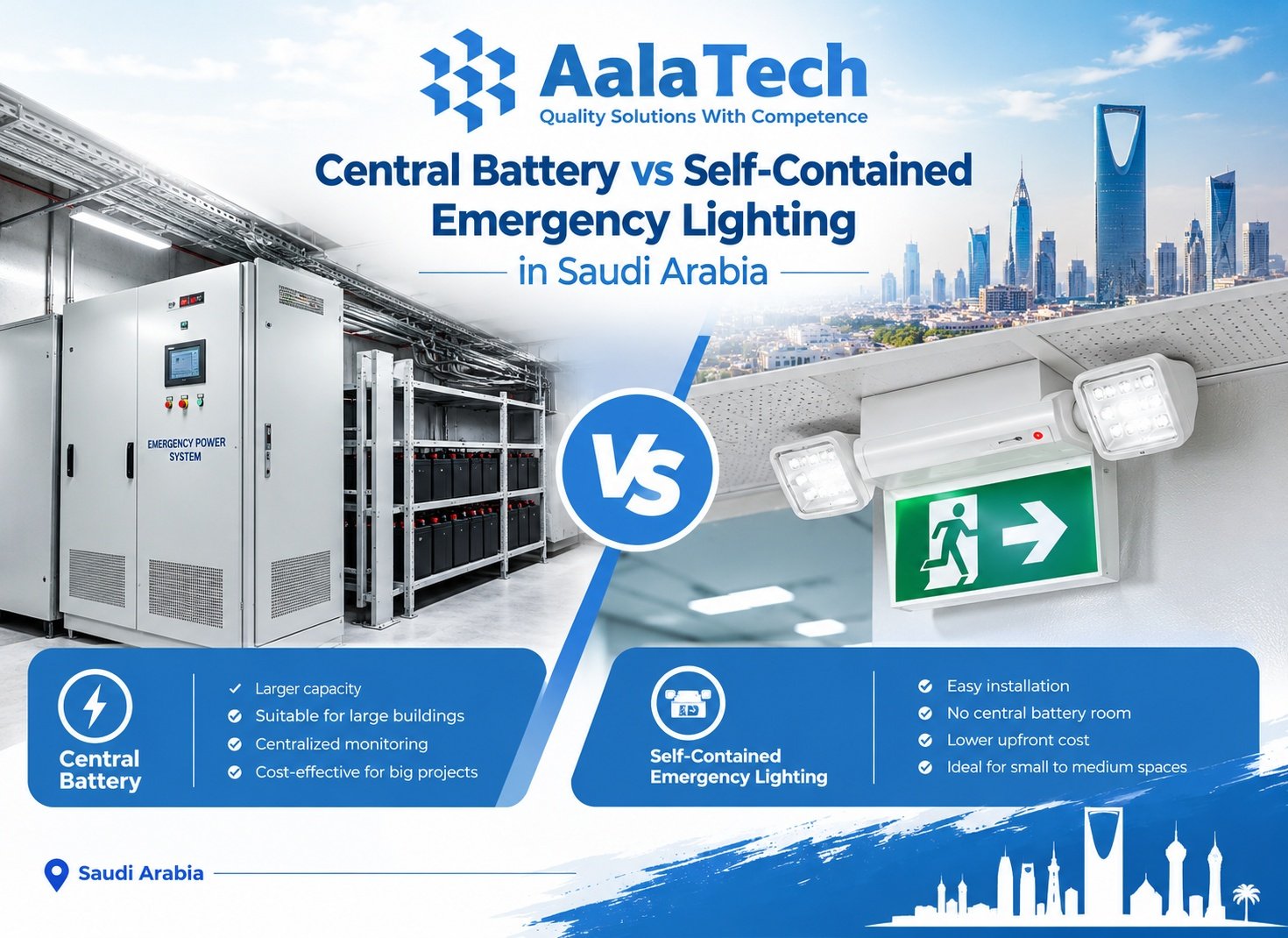
Both approaches can meet Civil Defense and NFPA 101 requirements. The right choice depends on building size, climate, maintenance capacity, and long-term cost. This guide compares the two systems for Saudi conditions and shows when each makes sense. Looking for reliable emergency lighting solutions in Saudi Arabia? Explore Aala Tech’s emergency lighting and central battery systems.
How the Two Systems Work
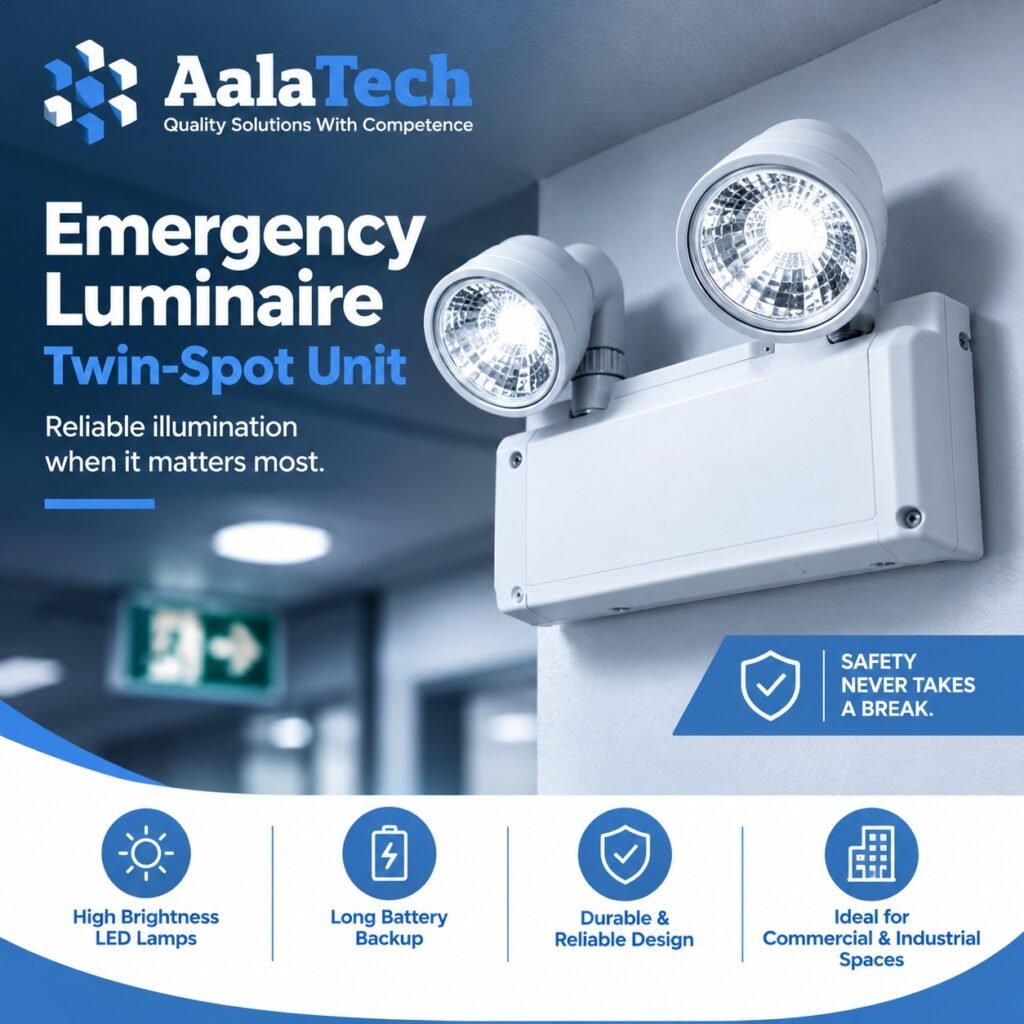
Self-contained emergency lighting places a battery, charger, and control gear inside (or next to) every luminaire. When mains power fails, each fitting switches independently to its own battery. Installation is straightforward standard cabling is usually sufficient and the system is easy to expand.
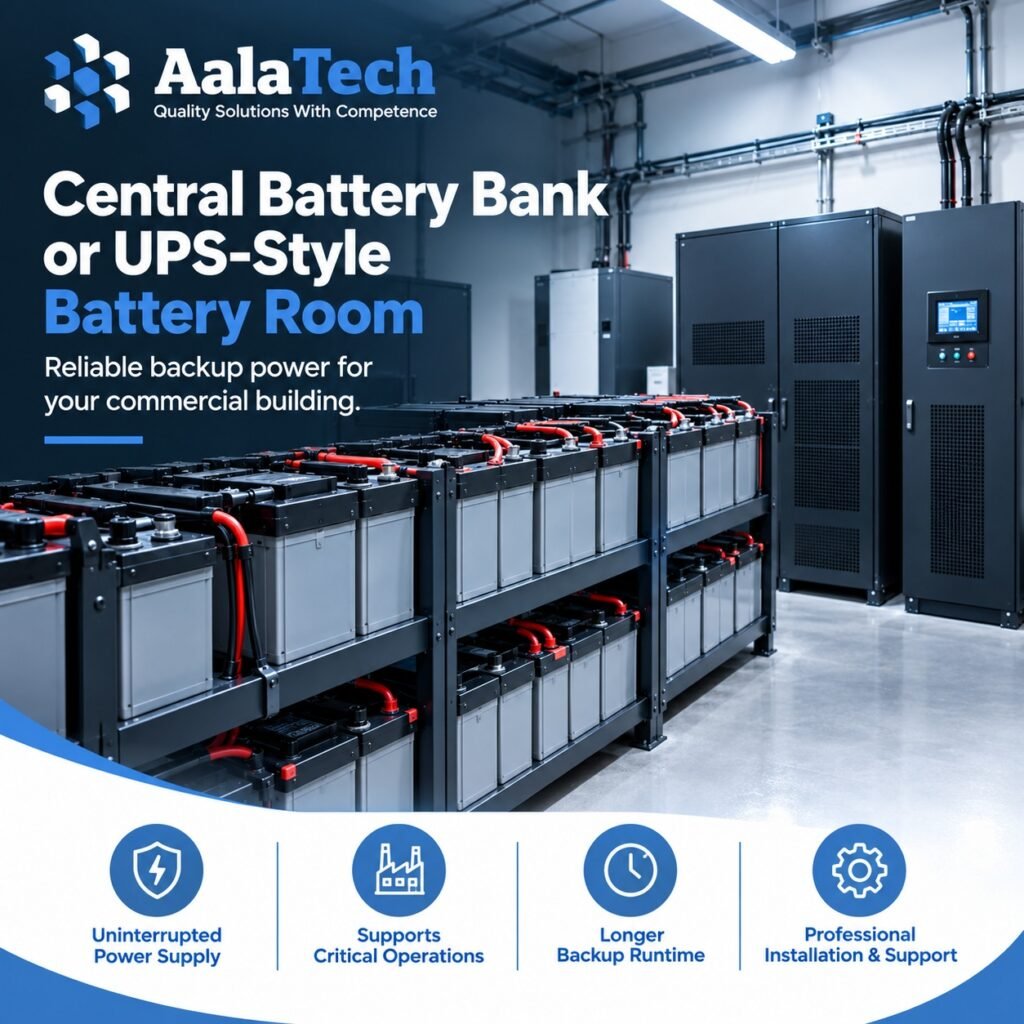
Central battery systems (also called central power supply or CPS) house a single battery bank, charger, and changeover equipment in a protected room. Dedicated circuits feed “slave” luminaires that have no onboard battery. When power fails, the central unit supplies every connected light.
Both must deliver a minimum of 90 minutes of illumination at the required light levels (typically averaging 1 foot-candle / ~10.8 lux along the egress path under NFPA 101 principles adopted in the Saudi Building Code). See the official NFPA 101 Life Safety Code for detailed requirements.
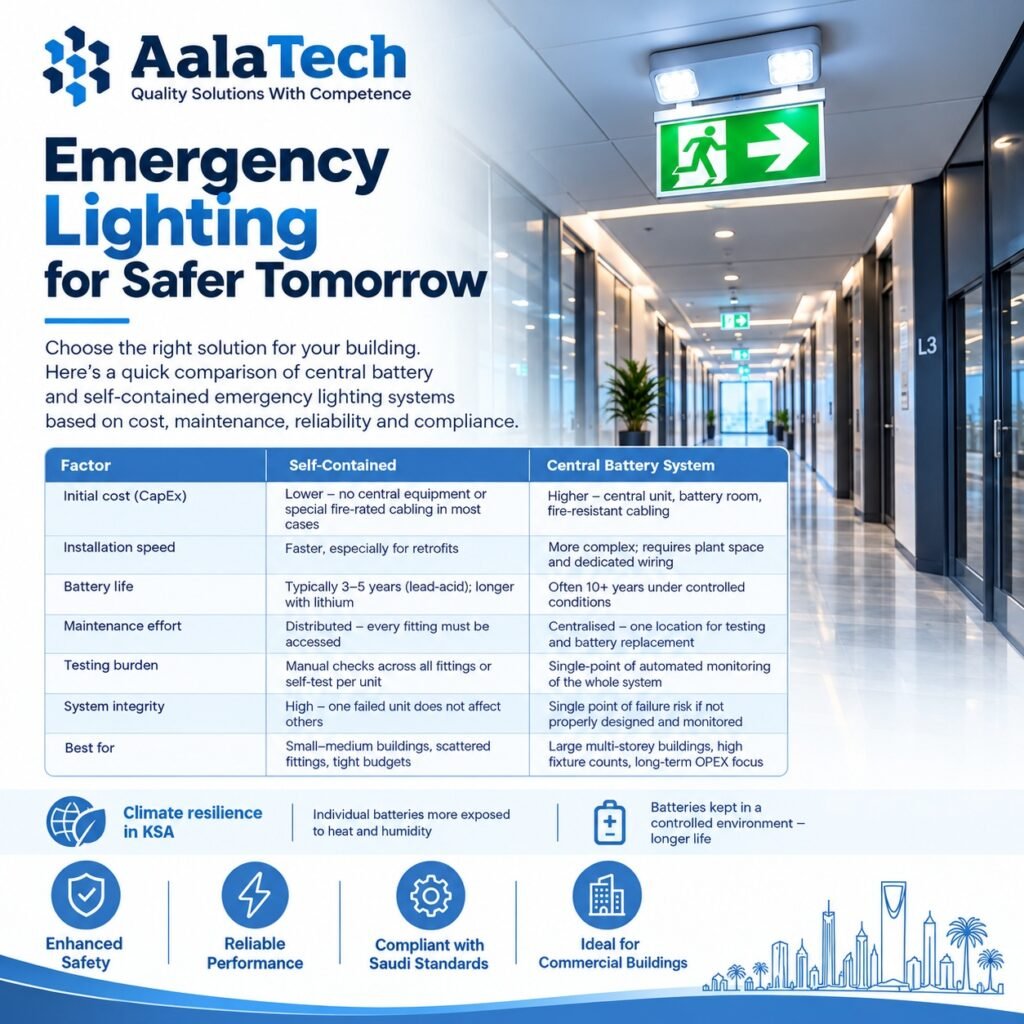
Industry experience shows that self-contained systems usually win on first cost for projects under roughly 50–100 fittings. Above that range, the higher capital cost of a central system is often recovered within 8–12 years through lower battery replacement and labour costs. This aligns with guidance from manufacturers such as Eaton and independent analyses.
Saudi Climate and Building Realities
Saudi conditions change the equation. High ambient temperatures accelerate battery degradation. Coastal humidity and salt air in Jeddah and Dammam further stress sealed batteries. Dust in inland sites can affect fittings. In large commercial, hospitality and industrial projects driven by Vision 2030, fixture counts frequently run into the hundreds.
Central battery systems keep the energy source in a cooler, cleaner, monitored room. That single change extends battery life and simplifies the monthly 30-second functional tests and annual 90-minute duration tests required under the rules enforced through the Salamah platform. Self-contained systems remain fully acceptable for compliance provided every unit is tested and documented, but the labour burden grows quickly.
When to Choose Self-Contained Emergency Lighting
Choose self-contained when:
- The building is small or medium-sized with relatively few emergency fittings.
- You are retrofitting an existing property and want minimal disruption.
- Capital budget is tightly constrained and long-term maintenance staff are available.
- Future expansion is uncertain and flexibility is important.
Many retail units, smaller offices and low-rise buildings across the Kingdom still rely successfully on well-maintained self-contained systems. For further reading on system selection, see Philip Payne’s guidance on self-contained vs central battery.
When a Central Battery System Is the Better Choice
Central systems become compelling when:
- Fixture counts are high (typically above 100).
- The building is multi-storey or has complex egress routes.
- You want simplified testing records for Civil Defense inspections.
- Lifecycle cost and reduced disruption matter more than lowest first cost.
- Integration with a Building Management System is planned.
Hospitals, hotels, shopping malls, data centres, large commercial towers and industrial facilities in Riyadh, Jeddah, Dammam and Madinah increasingly specify central battery systems for these reasons.
City-Specific Considerations Across Saudi Arabia
Riyadh:
Dense commercial towers and government buildings face strict scrutiny. An experienced emergency lighting system supplier in Riyadh designs systems that pass Civil Defense inspection and keep testing records ready. Central systems suit the scale of many capital projects. Search terms such as emergency lighting companies in Riyadh and emergency lighting solutions in Riyadh frequently lead facility managers to local specialists who understand both self-contained and central options.
Jeddah
Coastal humidity and high occupancy in hospitality and commercial properties favour robust equipment and disciplined maintenance. Emergency lighting solutions in Jeddah that use central battery systems reduce the impact of heat and moisture on individual batteries. Facility managers looking for emergency lighting companies in Jeddah or an emergency lighting system supplier in Jeddah prioritise suppliers who plan for local climate.
Madinah
Seasonal peaks in visitor numbers place heavy demands on hotels and public buildings. Clear, reliable exit illumination is essential. Emergency lighting solutions in Madinah based on a central battery approach simplify ongoing testing during high-occupancy periods. Terms such as emergency lighting companies in Madinah and emergency lighting system supplier in Madinah reflect the need for dependable local support.
Dammam and the Eastern Province
Industrial plants, warehouses and commercial facilities face heat, dust and demanding duty cycles. Emergency lighting solutions in Dammam that centralise batteries improve reliability and reduce the number of access points for maintenance teams. Search interest in emergency lighting companies in Dammam and emergency lighting system supplier in Dammam continues to grow with industrial expansion.
Across all cities, the same national rules apply. The difference lies in building scale, climate stress and the capacity of the facilities team. Working with established emergency lighting companies in Saudi Arabia that offer both system types and local service coverage remains the most practical route to compliance and long-term performance.
Testing, Documentation and Civil Defense Reality
Saudi requirements follow NFPA 101 principles: a monthly functional test of at least 30 seconds and an annual full-duration test of 90 minutes, with written records retained for inspection via the Salamah system. For a practical Saudi-focused overview, see Emergency Lighting Standards: NFPA 101 and Saudi Civil Defense Compliance.
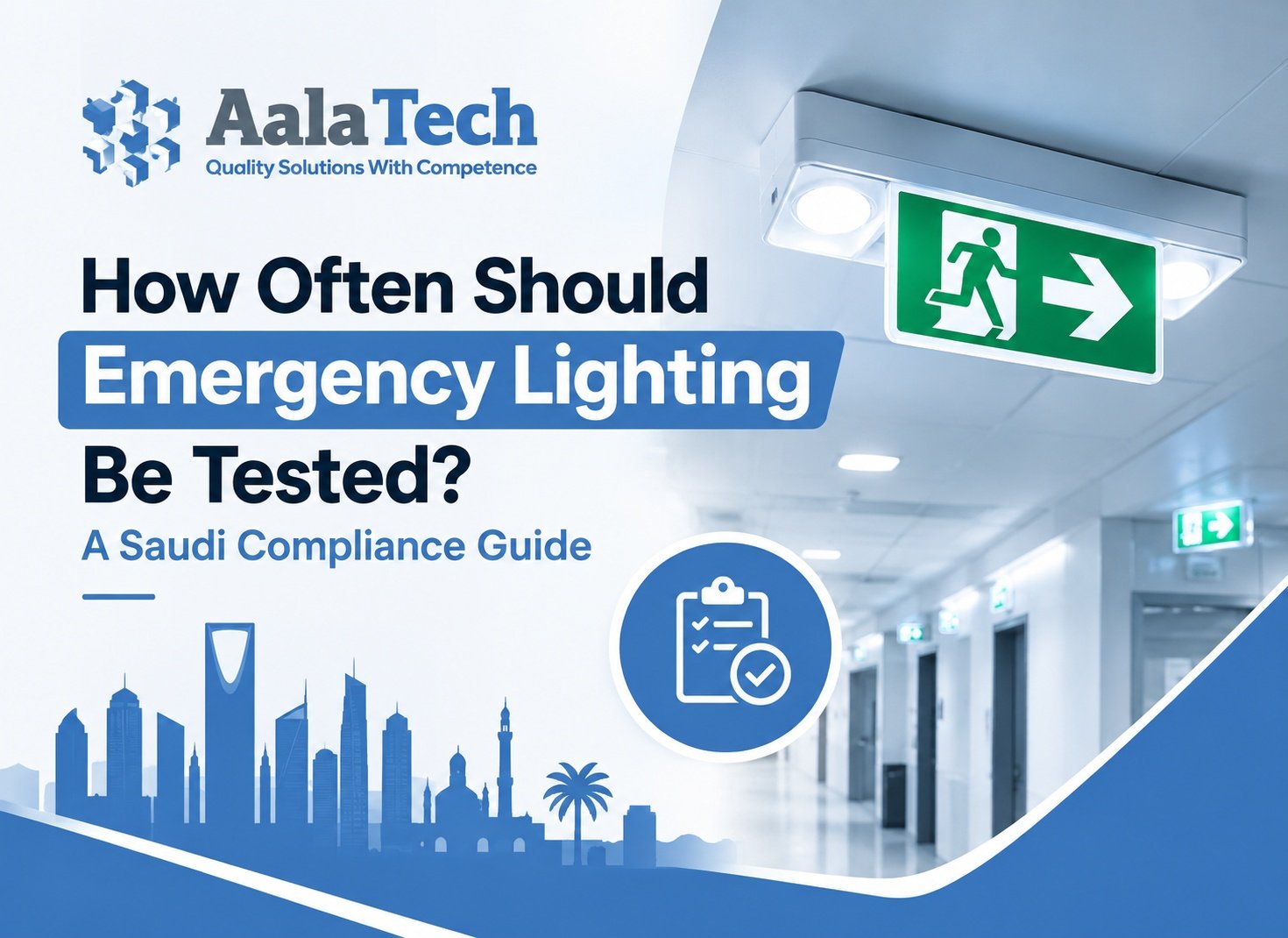
Self-contained systems require either manual testing of every fitting or individual self-test capability. Central systems allow testing and monitoring from one location (or automatically), which dramatically reduces the risk of incomplete records—the most common reason buildings fail inspection. For a detailed schedule and practical advice, see Aala Tech’s guide on How Often Should Emergency Lighting Be Tested? A Saudi Compliance Guide.
Making the Decision
Ask three questions:
- How many emergency fittings will the building have?
- How easy is it for your team (or contractor) to access every fitting regularly?
- Do you priorities lowest capital cost or lowest total cost of ownership over 10–15 years?
If the answers point to a large, multi-storey or high-occupancy building under Saudi climate stress, a central battery system usually delivers better long-term value and simpler compliance. For smaller or retrofit projects, self-contained units remain a sound, code-compliant choice.
Aala Tech designs, supplies and maintains both approaches across the Kingdom. As a leading emergency lighting system supplier in Saudi Arabia, we start with a site survey, match the system to the building and Civil Defense expectations, and provide the documentation inspectors expect.
Ready to choose the right system for your building?
Contact Aala Tech for a practical recommendation on central battery or self-contained emergency lighting solutions in Saudi Arabia, including Riyadh, Jeddah, Madinah and Dammam. Talk to our team or call +966 56 921 6835.
Frequency Asked Questions
Self-contained units each carry their own battery. A central battery system powers multiple luminaires from one battery bank in a protected room. Central systems simplify maintenance and often last longer; self-contained systems are simpler and cheaper to install on smaller projects.
Central battery systems are usually preferred for multi-storey commercial, hospitality and industrial buildings because batteries are protected from heat, testing is centralised, and long-term costs are lower once fixture counts rise.
Yes. Both can satisfy NFPA 101 principles adopted in the Saudi Building Code and Salamah inspections, provided they deliver the required illumination for at least 90 minutes and are tested and documented correctly.
Self-contained batteries typically need replacement every 3–5 years. Central battery systems commonly achieve 10 years or more when housed in controlled conditions.
Initial cost is higher. Over 8–12 years the lower maintenance and battery replacement costs often make it the more economical choice for larger installations.
High humidity, salt air and heat accelerate degradation of individual batteries. Central systems keep batteries in a better environment and reduce exposure.
Look for suppliers with local engineering presence, Civil Defense experience and the ability to supply and maintain both self-contained and central battery solutions. Aala Tech provides coverage across these cities.