How Often Should Emergency Lighting Be Tested? A Saudi Compliance Guide

How Often Should Emergency Lighting Be Tested? A Saudi Compliance Guide

Emergency lighting testing is the part of building safety that everyone agrees is important and almost everyone puts off. The lights sit quietly in the ceiling for years, and it is easy to assume they will simply work when the power fails. Then a Civil Defense inspector asks for your test records, and the assumption becomes a problem.

This guide explains exactly how often emergency lighting must be tested in Saudi Arabia, what each test involves, and how the rules are actually enforced here. As an experienced emergency lighting system supplier in Saudi Arabia, Aala Tech deals with these inspections every week, so this is written from what the authorities really check, not from theory.

Why Emergency Lighting Testing Is Not Optional?

Emergency lighting has one job. When the mains power fails, it illuminates the escape route long enough for everyone to get out safely. A fitting that has quietly lost battery capacity looks identical to one that works, right up to the moment it is needed and fails.

That is why testing exists. It is the only way to know a system will perform, and in Saudi Arabia it is a legal duty, not a best practice. The building owner or occupier carries responsibility for keeping the system tested, documented, and ready.

Skipping it carries real consequences. A building can fail its safety inspection, lose or delay its operating licence, and expose its owner to liability if an incident occurs. Reliable emergency lighting solutions in Saudi Arabia are only reliable if they are proven on a schedule.

How Saudi Arabia Regulates Emergency Lighting?

Here is the piece the international guides leave out.

In Saudi Arabia, emergency lighting falls under the Saudi Building Code, specifically the fire protection requirements in SBC 801, which adopt the principles of the international Life Safety Code, NFPA 101. Enforcement sits with the General Directorate of Civil Defense.

In practice, compliance runs through the Salamah platform, the Civil Defense licensing and inspection system that commercial and public buildings must pass to obtain and keep a safety licence. The materials and equipment themselves are expected to meet SASO standards. So a compliant system in the Kingdom means the right SASO recognised equipment, installed to code, and tested on the NFPA schedule, with records ready for Civil Defense.

Understanding that chain matters, because it explains why testing records are not paperwork for its own sake. They are the evidence an inspector asks for.
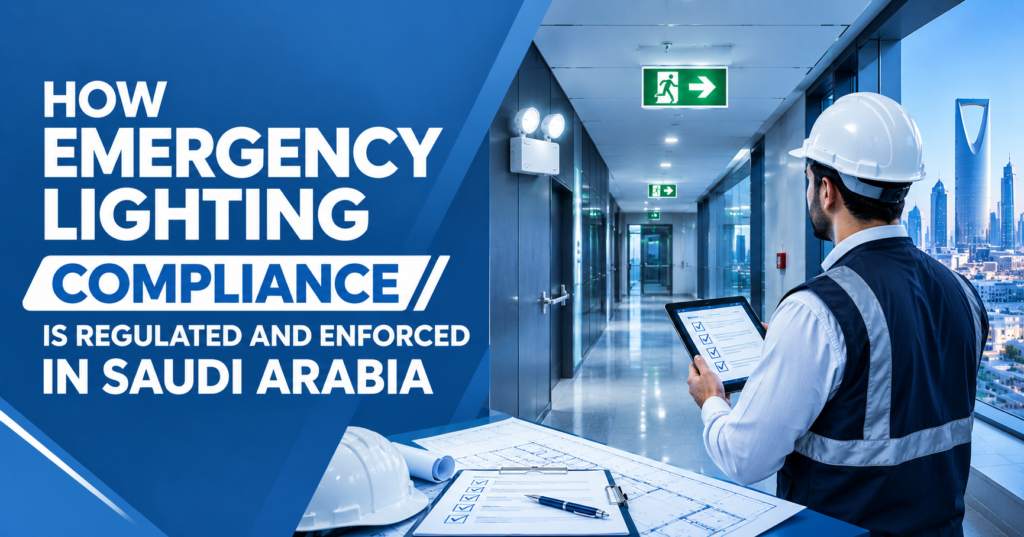
How emergency lighting compliance is regulated and enforced in Saudi Arabia

The Monthly Functional Test

The first requirement is a short monthly test.

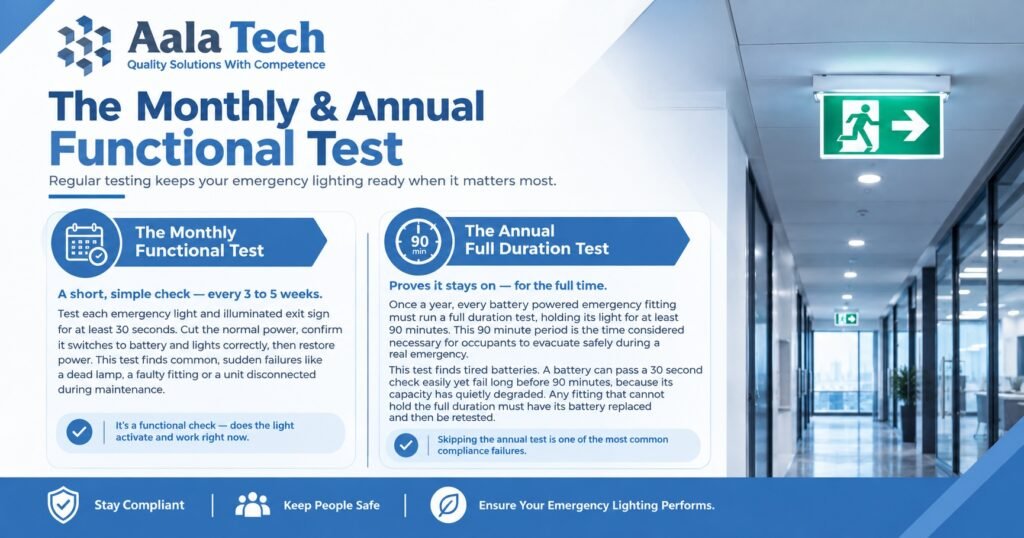
Every emergency light and illuminated exit sign should be tested for at least 30 seconds, roughly once a month, with the interval kept between three and five weeks. The test is simple in principle. You cut the normal power to the fitting, confirm it switches to battery and illuminates correctly, then restore power.

This is a functional check, not an endurance one. It answers a single question: does the light activate and work right now. It catches the common, sudden failures, a dead lamp, a fitting that no longer switches over, a unit that someone disconnected during maintenance and never reconnected.

For a building with a handful of fittings, this is quick. For a hotel or hospital with hundreds, testing each one by hand every month becomes a serious task, which is where automatic self testing changes the picture later in this guide.

Emergency lighting testing schedule showing the monthly and annual tests

The Annual Full Duration Test

The monthly test proves the light comes on. The annual test proves it stays on.

Once a year, every battery powered emergency fitting must run a full duration test, holding its light for the complete rated period, which for most systems is a minimum of 90 minutes. This 90 minute figure is not arbitrary. It reflects the time considered necessary for occupants to evacuate safely during a real emergency.

This is the test that finds tired batteries. A battery can pass a 30 second check easily yet fail long before 90 minutes, because its capacity has quietly degraded with age and heat. Any fitting that cannot hold the full duration must have its battery replaced and then be retested.

Skipping the annual test is one of the most common compliance failures, precisely because the monthly test gives false comfort. The lights come on, so everything seems fine, until the one test that actually matters is never run.

What Records You Have to Keep?

A test that is not documented did not happen, as far as an inspector is concerned.

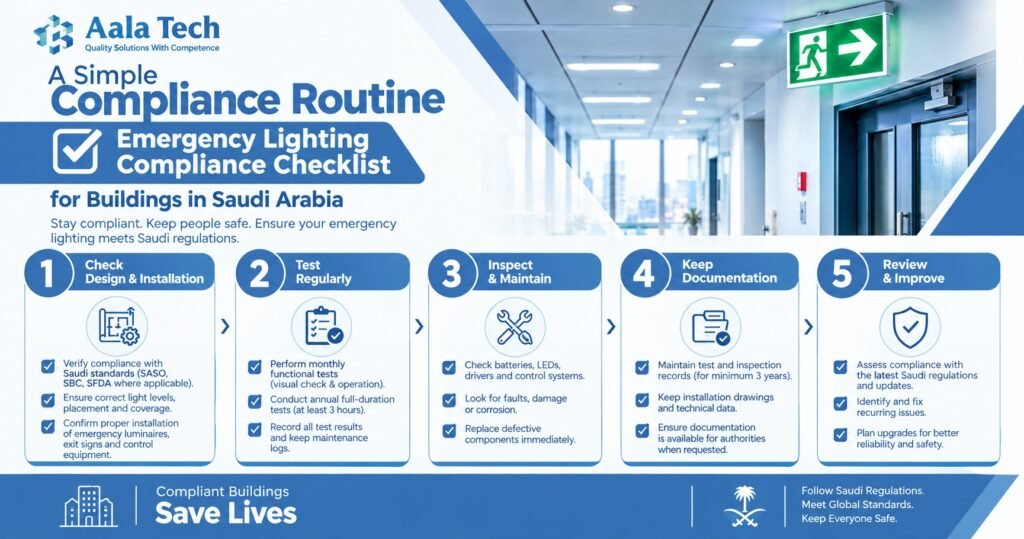
Written records of every test must be kept and made available for review. Each entry should note the date, what was tested, the result, any faults found, and any repair or battery replacement carried out. These records need to be retained over time, because Civil Defense may ask to see a history, not just the latest check.

Good documentation does more than satisfy an inspection. It shows a pattern of care, it supports any insurance claim after an incident, and it flags batteries that are trending toward failure before they actually fail.

Where Manual Testing Quietly Falls Apart

On paper, the schedule is straightforward. In a large building it rarely survives contact with reality.

Manual monthly testing across hundreds of fittings takes time that busy facilities teams do not have, so it slips. The annual 90 minute test is even easier to postpone, because it needs planning and someone on site for the full duration. Records get patchy. Batteries age unnoticed. By the time an inspection arrives, nobody is quite sure which fittings were last checked or when.

None of this means the building owner is careless. It means the manual process does not scale. This is the single most common reason otherwise well run buildings struggle at inspection time.

How Automatic Self Testing Solves It?

Modern systems remove most of this burden.

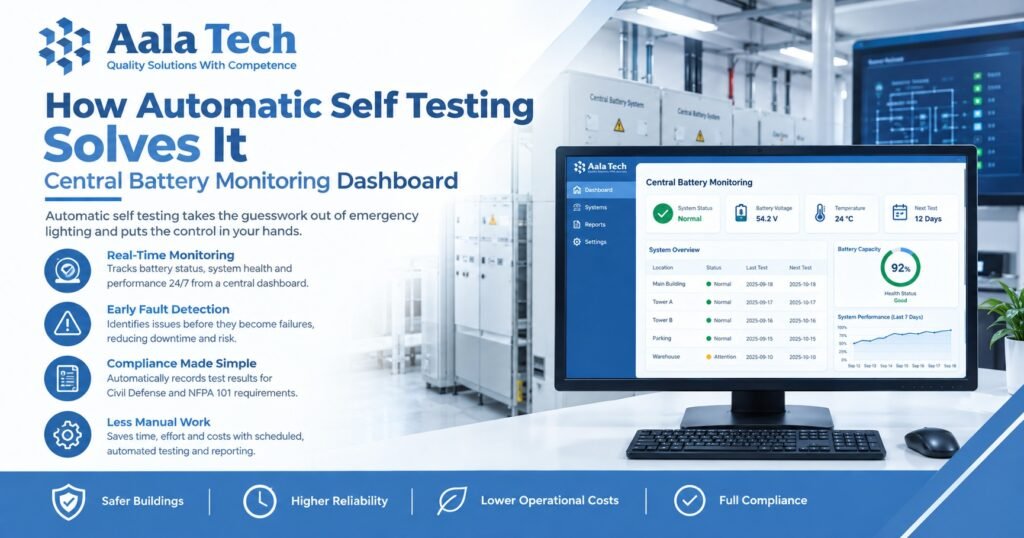
Self testing emergency fittings, and centrally monitored central battery systems, run their own functional and duration tests automatically on the required schedule. They log every result, flag any fitting that fails or any battery that is weakening, and present it all from one dashboard. A quick visual inspection is still worth doing, but the testing and the record keeping happen without a technician walking every corridor with a clipboard.

For a facility manager in the Kingdom, that is the difference between hoping the records are complete and knowing they are. It is also why larger buildings increasingly specify self testing or central battery systems from the outset. The best emergency lighting companies in Saudi Arabia now design monitoring in rather than bolting it on afterward.

Compliance Across Saudi Arabia’s Major Cities

The national rules are the same everywhere, but the buildings and the pressures differ by city, and a capable emergency lighting supplier in Saudi Arabia designs for that.

In the capital, government buildings, corporate towers, and institutions face close scrutiny, so working with an emergency lighting system supplier in Riyadh that understands Civil Defense expectations keeps projects on schedule. Along the coast, humidity and heat shorten battery life, which is why emergency lighting solutions in Jeddah lean on robust equipment and disciplined annual testing. In the Eastern Province, industrial and commercial facilities run demanding duty cycles, so emergency lighting companies in Dammam are judged on reliability and fast fault response. And in Madinah, hotels and public buildings handle huge seasonal swings in occupancy, which makes dependable emergency lighting solutions in Madinah essential during peak periods.

Whether you need an emergency lighting supplier in Dammam, an emergency lighting system supplier in Jeddah, an emergency lighting supplier in Madinah, or emergency lighting companies in Riyadh, the compliance standard is identical. What varies is the building, and the design should follow it.

The Most Common Reasons Buildings Fail

A few failure patterns come up again and again, and all of them are avoidable.

The first is the untested annual duration. Teams do the quick monthly checks, see the lights come on, and never run the 90 minute test that actually proves the batteries. The second is aged batteries in a hot climate, because heat is hard on cells and Saudi building management system run their cooling hard, so capacity fades faster than owners expect. The third is missing records, where the testing may even have happened but nothing was written down, so there is nothing to show an inspector.

The last one is subtler. A system was installed years ago by whoever was cheapest, with no plan for how it would be maintained, and no single party now owns it. When responsibility is unclear, testing simply falls through the cracks. Naming one accountable owner, internal or a maintenance partner, fixes more compliance problems than any single piece of hardware.

A Simple Compliance Routine

To keep it manageable, the whole obligation comes down to a short routine.

Test every fitting for 30 seconds each month. Run the full 90 minute duration test once a year. Write down every result and keep the history. Replace any battery that fails the duration test and retest it. And where the building is large, let a self testing or central battery system carry the load automatically.

Do that consistently and a Civil Defense inspection stops being a scramble and becomes a formality.

Getting It Right From the Start

Most compliance trouble traces back to a system that was installed cheaply and never maintained, or one designed with no thought for how it would be tested. The fix is to treat testing as part of the design, not an afterthought.

That is how we work. Aala Tech designs, installs, and maintains emergency lighting and central battery system that are built to be tested and documented, and we keep the records inspection ready. If you want a system that passes without the annual panic, our team can survey your building and show you exactly where it stands today.

Frequently Asked Questions For How Often Should Emergency Lighting Be Tested?

How often should emergency lighting be tested?

Emergency lighting should be tested monthly and annually. The monthly test is a short functional check of at least 30 seconds, done every three to five weeks, confirming each light switches to battery. The annual test is a full duration test, usually 90 minutes, proving the battery lasts.

For most battery powered systems, emergency lighting must stay illuminated for a minimum of 90 minutes during the annual full duration test. This reflects the time occupants need to evacuate safely. Any fitting that cannot hold the full 90 minutes needs its battery replaced and then retested.

In Saudi Arabia, emergency lighting falls under the Saudi Building Code and NFPA 101, enforced by the General Directorate of Civil Defense. Compliance is confirmed through the Salamah platform, and equipment is expected to meet SASO standards. Civil Defense may request your test records during inspection.

Keep a written log of every monthly and annual test, recording the date, what was tested, the result, any faults, and any repairs or battery replacements. These records must be retained over time and made available to Civil Defense, since inspectors often review the full history, not just recent checks.

A fitting that fails must be repaired or its battery replaced immediately, then retested to confirm it works. A failed light is both a safety risk and a compliance breach. Weak batteries that cannot hold the 90 minute duration are the most common cause and should be replaced without delay.

Yes. Self testing fittings and centrally monitored central battery systems run functional and duration tests automatically, log the results, and flag any failure from one dashboard. This removes the burden of manual monthly checks and keeps records inspection ready, though a periodic visual inspection is still recommended.

The building owner or occupier is responsible for ensuring emergency lighting is tested, maintained, and documented. Many delegate the work to a specialist emergency lighting supplier in Saudi Arabia who carries out the tests, keeps the records, and ensures the system stays ready for Civil Defense inspection.

Get a Quote